
File 09 · Lucifer OOI
The Weather Is Not the Climate
First transmission · lecture hall, not the pit

First transmission
Platforms, High-Arousal Imagery, and Circular Reporting from Thin Sources
The old world sold paper. This one sells seconds of a nervous system. Platforms do not merely host speech; they run a two-sided market in which the scarce commodity is human attention and the cheapest fuel is high-arousal imagery. Into that market slides an older intelligence failure with a new costume: circular reporting — one claim wearing many hats until it looks like a crowd. The thesis is simple and unkind.
Reach is not corroboration.
Heat is not evidence.
Echo is not consensus.
A public that cannot tell those three apart will live under weather it mistakes for climate.
I
The market
Herbert Simon said it before the feed existed: a wealth of information creates a poverty of attention. Platforms industrialised the poverty. They do not charge most users in cash. They charge in dwell time, then sell the residue to advertisers and to the ranking function itself. Content producers, as recent work on Reddit and TikTok shows, respond to that currency with almost animal fidelity: after a post goes viral, output roughly doubles for a month. Attention is wages. The labour supply curve is concave — the first likes matter more than the ten-thousandth — which is why the market never rests. It must keep finding new spikes.
Galtung and Ruge, writing in 1965 about foreign news, already listed the traits that would later become engagement features: frequency, threshold, unexpectedness, elite persons, negativity, unambiguity. The algorithm did not invent those appetites. It priced them. What changed is speed and scale. Lorenz-Spreen and colleagues modelled collective attention as topics competing for a finite pool; the result is shorter half-lives and steeper rises. The weather turns faster. The climate — the slow facts — gets less air.
Reuters Institute reporting in the mid-2020s only confirms the shift of where the weather is made: social and video networks overtaking television and owned news sites as the average source, with the youngest cohort treating platforms and chatbots as first contact. That is not a moral verdict. It is a change of factory.
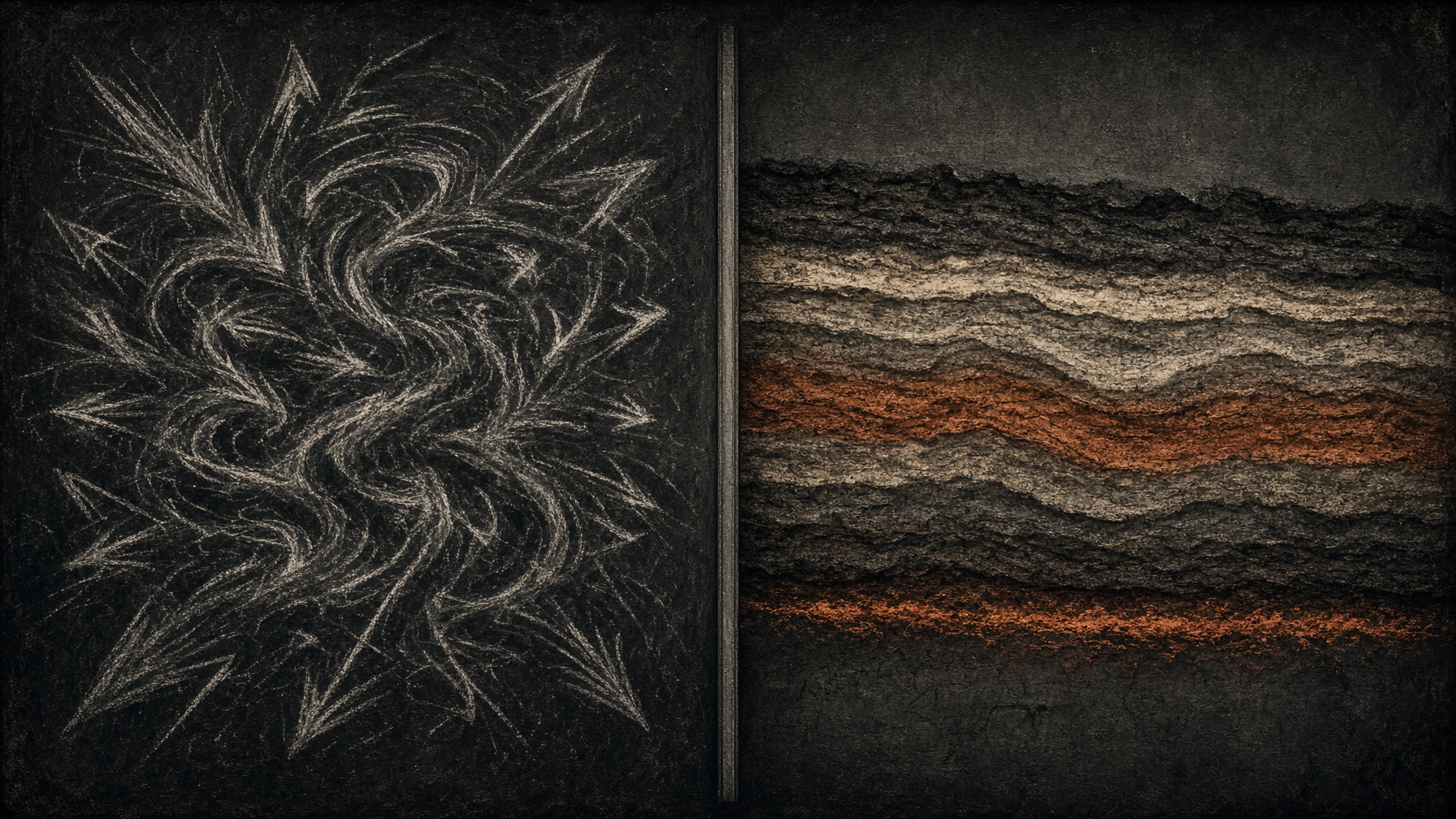
II
High-arousal imagery sets the weather
Valence is the sign of the feeling — good or bad. Arousal is the voltage. Sharing follows voltage more than sign. Jonah Berger’s line of work, and the studies that followed it into Instagram, TikTok, and short video, keep finding the same pattern: anger, awe, and anxiety travel; sadness, which is negative but low-arousal, does not. A Stanford analysis of tens of thousands of TikTok “storytime” videos found arousal predicting engagement while valence described a U-shape: extremes beat the middle. Intensity, not niceness, is the product.
This is physiology wearing a product manager’s badge. High arousal prepares the body to act — share, reply, pile on — before the prefrontal cortex has finished the footnote. Platforms that optimise for watch-time and reply-rate are, whether they confess it or not, optimising for that preparation. Internal and leaked analyses have long suggested emotionally charged political material out-engages the grey stuff by multiples. One need not romanticise a golden age of newspapers to admit the new ratio: the clip that makes the pulse jump is cheaper to distribute than the paragraph that makes the pulse settle.
High-arousal imagery has a further property useful to anyone who wishes to set weather: it travels without its context. A still of rubble, a scream, a rooftop, a child’s face — these are portable. They do not carry the casualty methodology, the opposing clip, the timeline, or the primary document. The image is the payload. The caption is optional. That is influence by reach, which is not the same as operational control of every mind. Audiences still exist. Secondary platforms still exist. Primary releases still exist. But the emotional weather most people live under is set by whatever wins the first two hours. That asymmetry is real. Pretending it is nothing is as dishonest as pretending it is monopoly.
III
Circular reporting: the crowd that is one man
Circular reporting — also called false confirmation — is the condition in which a fact appears to arrive from many independent sources while tracing to one. Intelligence services have known the disease for decades. The Niger uranium forgeries and the Curveball channel into Iraq WMD assessments remain the textbook: a daily drumbeat of reports created the feeling of confirmation when the community was, in the WMD Commission’s phrase, listening to one fabricator through layers of summary. The number of repetitions does not raise the truth of the original claim. It raises how true it feels.
Journalism and the open web added a name Randall Munroe put on a comic: citogenesis. A line is inserted. A newspaper cites the line. The line cites the newspaper. The public sees two sources. There is one.
On platforms the loop tightens. A creator posts. Aggregators scrape. Outlets rewrite the scrape as “reports say.” Influencers clip the outlets. The original poster quote-tweets the clip as proof the world has noticed. Count the URLs and you will swear you have a literature. Trace the bloodline and you have a single pulse.
Diagnostic
Lineage
Can you name the first camera, the first document, the first named witness — and then name a second that does not depend on the first? If not, you have volume, not breadth.
Diagnostic
Unrelatedness
Multiple sources that share a desk, a funder, a Discord, a wire, or a single anonymous drop are not multiple sources. They are a family reunion wearing different ties.
IV
How the two machines lock
High-arousal imagery and circular reporting are not separate vices. They are a coupling.
Arousal supplies velocity. Circular reporting supplies apparent plurality. Together they produce a weather system: one thin source, rendered as spectacle, copied until the copies look like a sky. Policy made in that weather — by voters, by staffers who live on the same apps, by models trained on the same scrape — will overweight the clip and underweight the ledger.
This is why “influence versus control” is not decorative language. Influence rides reach. Control requires starving the alternatives. Free societies still have OSINT collectives, competing platforms, primary releases, courts, and the dull habit of asking for the first source. Imperfect. Continuous. Better than calling the weather a conspiracy so complete that every denial becomes further proof.
The adult move is not to deny the market. It is to refuse its exchange rate. Demand the lineage line on every card: single-source loop, or several unrelated primaries. Weight the second higher, even when it is quieter. Especially when it is quieter. Low-arousal truth is still truth. It simply does not trend.
V
What remains after the sermon
Lucifer’s job, if he has one in a college essay, is not to bless a side. It is to name the mechanism so it can be failed.
A claim that cannot lose — that treats every clean document as deeper cover — is not analysis of platforms. It is a lock. Platforms are bad enough without our help. They already reward the scream and the copy. The corrective is boring and therefore unfashionable: primary evidence, independent second sources, full context over isolated emotion, and the humility to say I do not know when the lineage is a circle.
The weather will keep changing every ninety minutes. That is the business model. Climate is slower. It is built from things that can be wrong. If your theory cannot be wrong, you are no longer studying the market. You are living inside it.